In Abstracto, In Concreto: On Memory and Presence
Curated by Brice Arsène Yonkeu 16 May - 15 September 2026 Efie Gallery, Dubai United Arab Emirates
Featured Artists
Luke Agada (b. 1992, Nigeria)
Tunji Adeniyi-Jones (b. 1992, UK/ Nigeria)
Ludovic Nkoth (b. 1994, Cameroon)
Naïla Opiangah (b. 1994, Gabon)
The title of this exhibition operates on two registers at once. In abstracto, in concreto carries the cadence of philosophical and juridical discourse, where the abstract designates the general condition, the inherited structure, the categorical weight of history, and the concrete designates the particular case, the embodied instance, the irreducibly singular. But it redirects this logic toward the domain of painting. It is also, less obliquely, an alternative formulation of one of art’s most persistent axes: the relationship between abstraction and figuration. To hold both readings simultaneously is to begin to understand what the works gathered here propose.
The four artists in this exhibition — Tunji Adeniyi-Jones, Luke Agada, Ludovic Nkoth, and Naïla Opiangah — are painters of African descent who have each lived or continue to live the experience of diaspora, as subjects who must continuously negotiate their existence, their history, their ancestry, and their stories in order to be accounted for. This condition is not background to their work. It is the work. They move between abstraction and figuration not as a formal preference but as a necessity, rendering inherited forces into something present, sensory, and irreducibly their own. Abstraction here is not distance or retreat. It is a mode of insistence, a way of asserting interiority that legibility alone cannot provide.
James Baldwin wrote in his essay titled Autobiographical Notes: “I am what time, circumstance, history, have made of me, certainly, but I am, also, much more than that. So are we all.” The sentence’s grammar is the exhibition’s argument. The first clause names the determining weight of history as the condition that shapes before it can be questioned. The second insists on an excess no category can contain, a remainder, a vitality, a much more than that, which is precisely what painting, in these four practices, reaches toward. In Abstracto, In Concreto is less concerned with depicting bodies in their recognizable form than with asking how the body, sometimes present, sometimes dissolving, sometimes displaced, becomes a vessel for history, inheritance, and imagination.
Three interwoven threads run through the exhibition without dividing it into fixed zones. The first follows the surfaces where memory and inheritance accumulate, where what has been endured leaves its mark on form itself. The second traces the generative transformation that occurs when inherited material passes through mythological or surrealist registers, producing new lineages and hybrid worlds. The third attends to the body as a site of tenderness and care, insisted upon in its fullness, protected in its vulnerability. These threads interpenetrate across works and across practices, carried by materials that share a quality of immediacy and vulnerability: oil and charcoal move across canvas, accumulating and dissolving in equal measure; chalk pastel and graphite work into paper, holding the trace of pressure long after the hand has moved on. Across both supports, the movement between in abstracto and in concreto is felt as much as it is seen.
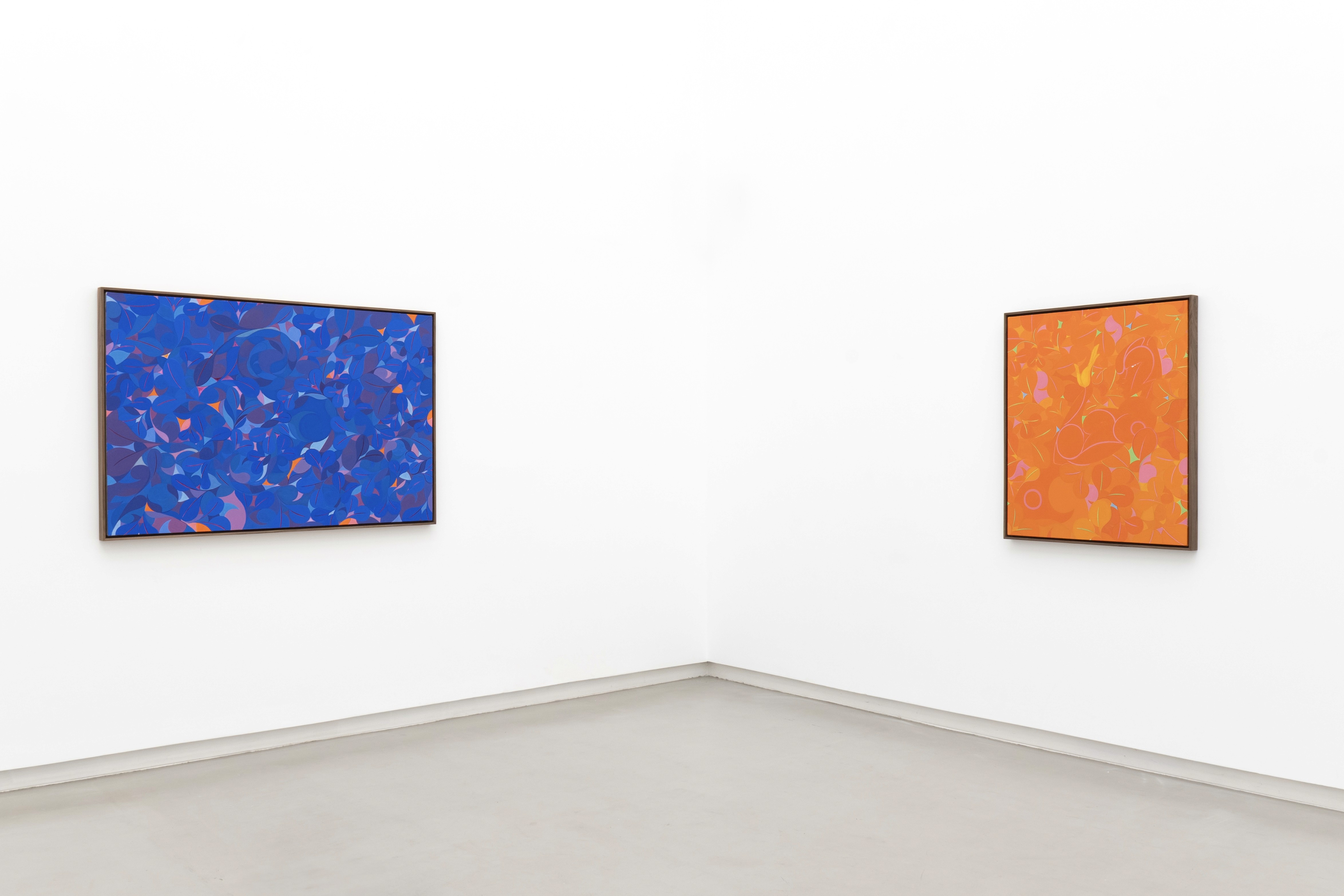
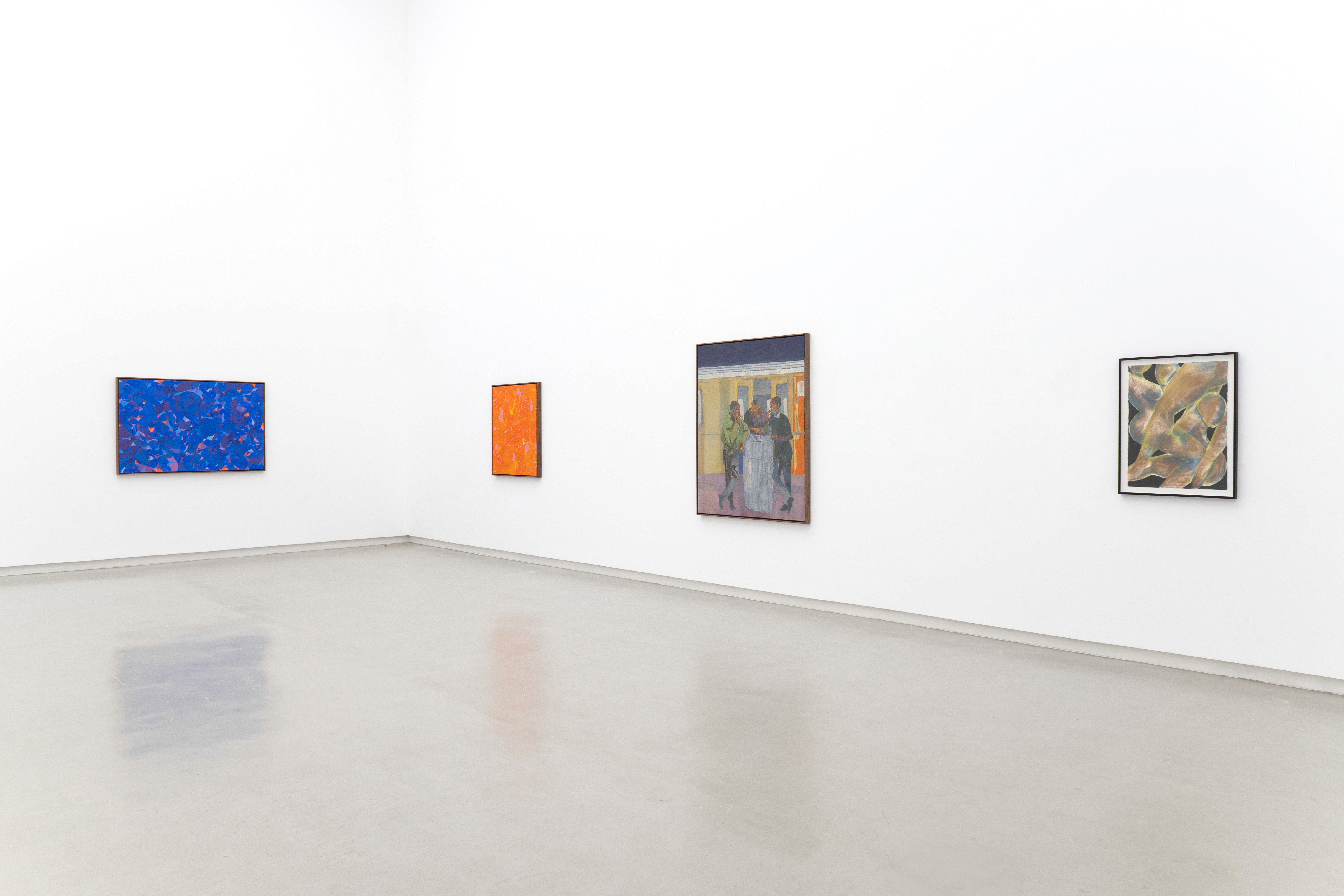
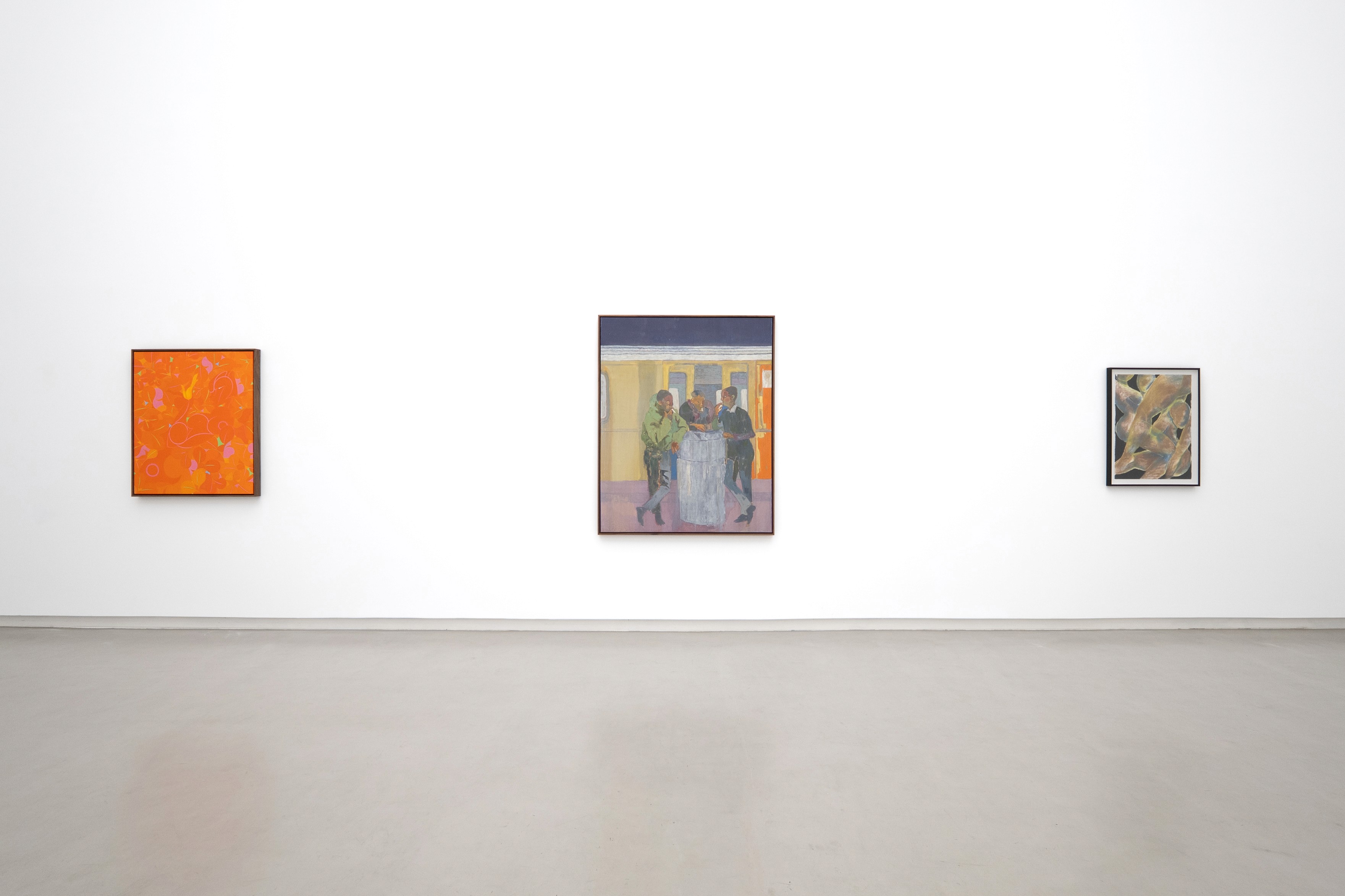
Tunji Adeniyi-Jones brings to this exhibition two oil paintings, Orange Sentinel and Blue Fragments, whose arresting fauvist palettes, recalling the chromatic audacity of Matisse, immediately claim the space around them. His is the most overtly mythological practice in the exhibition, one in which inherited spiritual worlds are not cited or illustrated but extended, reimagined as living, pulsating form. Yet color here is not decoration; it is cosmology. In Orange Sentinel, a mythical figure drawn from the deep reservoir of Yoruba deity and spiritual tradition
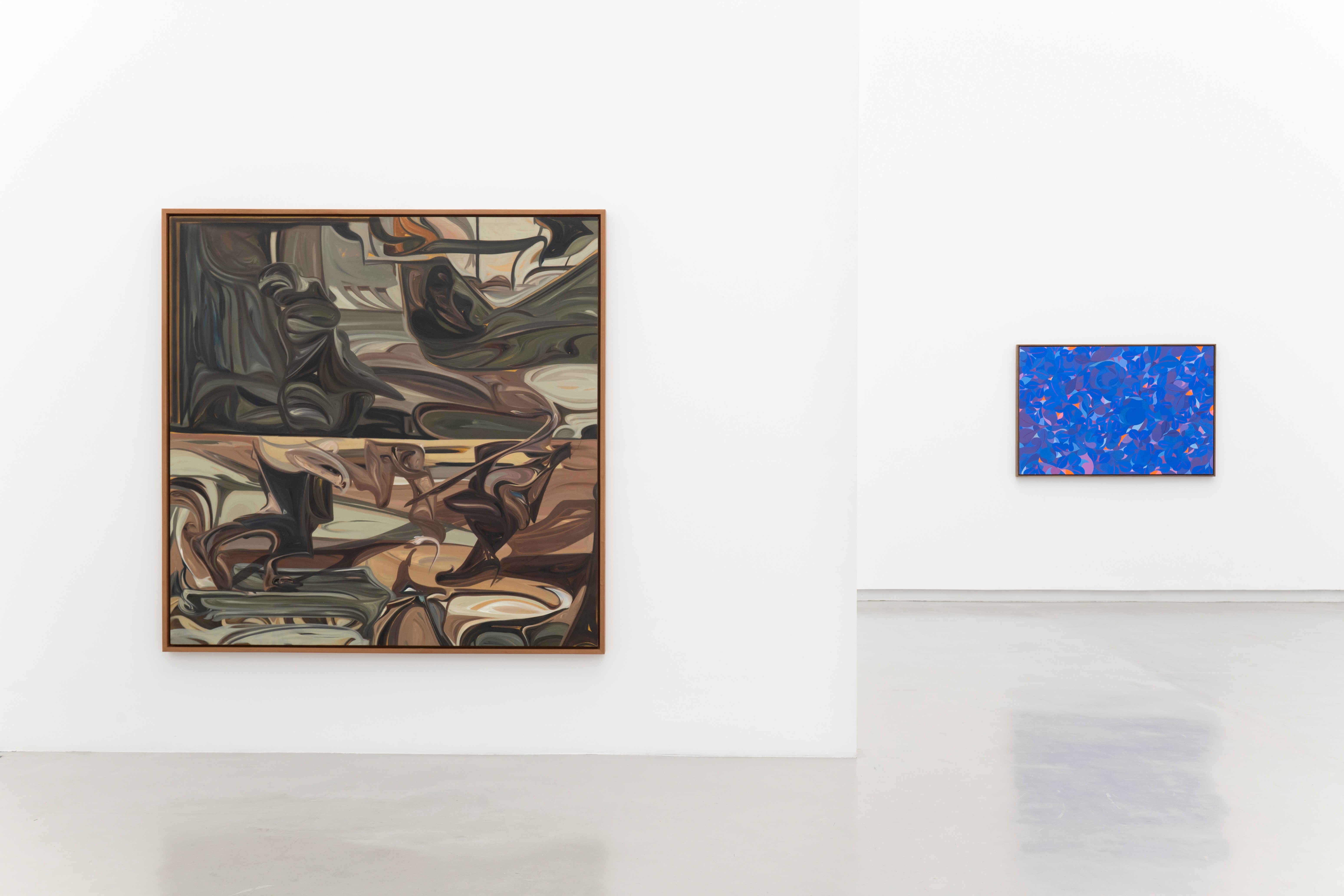
emerges through dense, luminous foliage, one arm extended, palm open toward the viewer: a guardian that is simultaneously a warning and an invitation, a form of the ancestral past assuming authority over the present. Blue Fragments marks a significant departure. The figures that characterize Adeniyi-Jones’s work have here completely withdrawn, retrieved into, or perhaps consumed by, a luxuriant field of blue leaves so meticulously rendered with pink, purple and orange undertones that the canvas becomes its own world. The viewer is not guided by a recognizable subject but plunged directly into the space itself, a pulsating color field that functions as both landscape and temporal passage, somewhere between ancestral memory and imagined future.
Born in the United Kingdom to Nigerian parents and formed in the most prestigious Western academies, Adeniyi-Jones is acutely conscious of where he stands in both art history and the world, a position that aligns him with a long lineage of African modernists for whom self-knowledge was the first condition of artistic making. As the Nigerian painter Yusuf Grillo stated in 1998: “The very first thing for an artist is to know who he or she is. You have to know where you are coming from.” Adeniyi-Jones knows precisely, and from that certainty makes paintings that do not illustrate mythology so much as extend it, and in Blue Fragments, push it toward something entirely new.
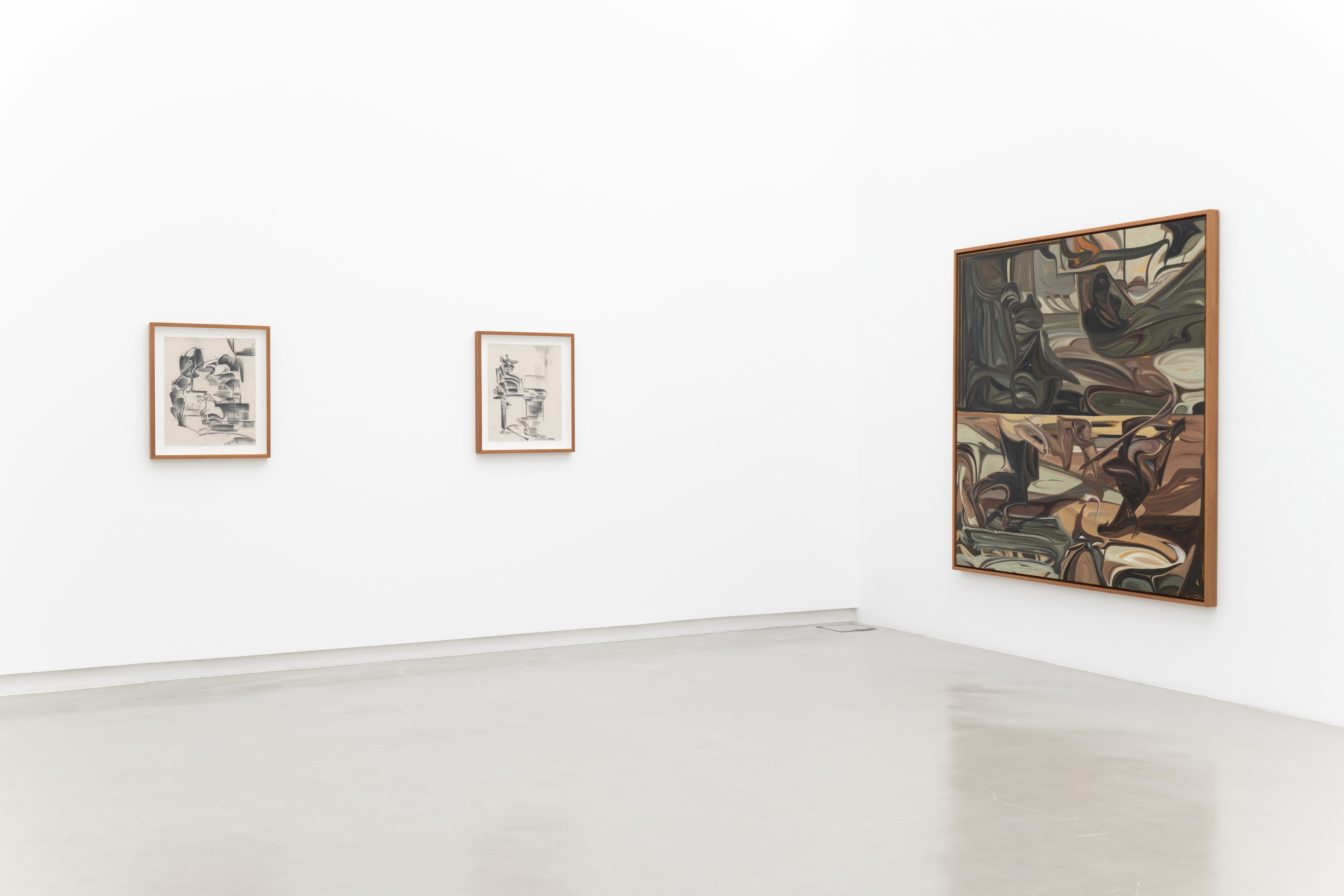
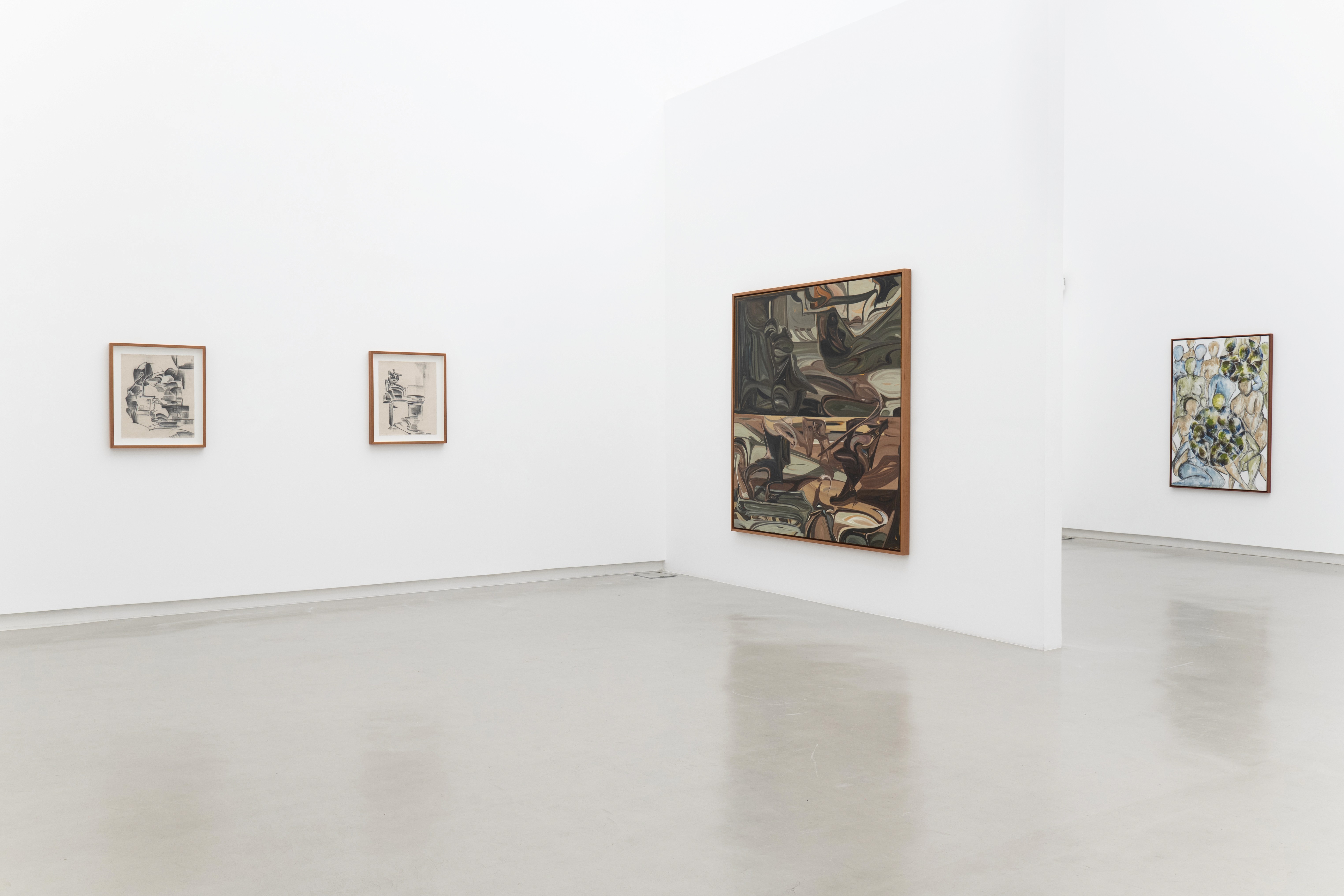
Luke Agada contributes three works that together span the full breadth of his artistic inquiry. Thresholds, an oil painting, opens on a question that is at once architectural and political: under what conditions does a body become admissible? The canvas is divided by a horizontal line that refuses to function as mere composition. It is a border, a suspended grammar of almost, the charged interval between here and elsewhere that Agada has come to understand as one of the defining structures of contemporary existence. Above and below it, paint moves with surrealist intensity: forms contort, merge, and dissolve, figuration giving way to abstraction in a continuous negotiation that mirrors the experience of a subject compelled to perpetually translate himself across systems of meaning.
Synapses No. 33 and Synapses No. 34 extend this inquiry into a more intimate key. Agada's charcoal drawings on canvas inhabit the logic of the synapse: dense, architectural, and faintly corporeal, their configurations accumulate and recede across the raw ground of the canvas as if capturing the instant of transfer itself, thought becoming form, memory becoming mark. If Thresholds asks what it means to wait at a boundary, the Synapses ask what it costs to cross one, and what is inevitably lost or transformed in the passage.
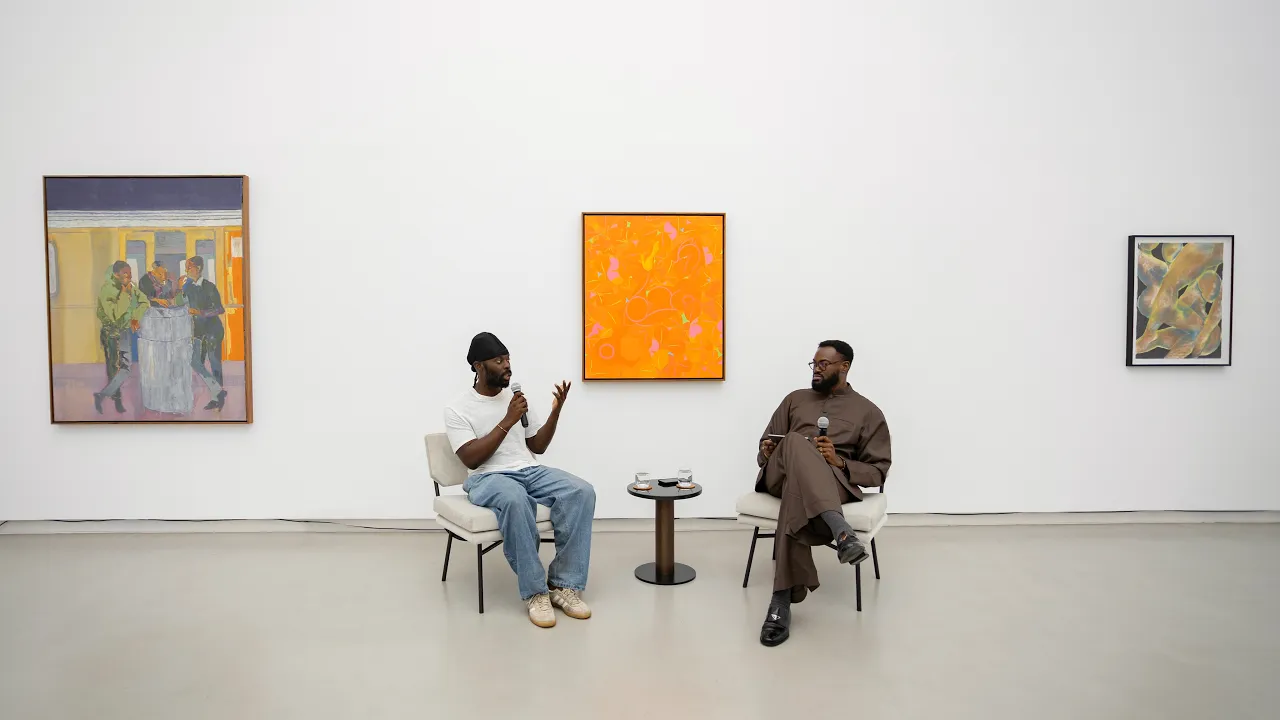
Where Agada renders the politics of transit through surrealist dissolution, Nkoth approaches the same condition from the opposite direction: not through pure abstraction but through the stubbornly particular. Smoke Break finds its power in the elevation of the deeply ordinary. Three figures, their skin registering in warm coffee browns and burgundy highlights, their features loosely indicated rather than defined, stand around a cylindrical table in a setting that refuses precise identification: an indoor pub, a terrace, a subway station, somewhere in-between. Each holds a cigarette. The gesture is banal, almost involuntary, yet Nkoth charges it with a quality of quiet seeking, figures pausing not merely to smoke but to gather themselves, to exist for a moment outside the demands of movement and negotiation.
What is particularly striking in Nkoth’s painting is the compositional language. Working in multiple layers of oil, Nkoth flattens perspectival depth in a way that recalls Noah Davis: space rendered not as it is seen but as it is remembered. Equally notable is how the cylindrical table at the center of the composition functions as more than a prop. The three figures arranged around it with a quiet intentionality that tips the scene toward the ceremonial — a smoke break transfigured, almost imperceptibly, into something closer to a ritual of collective endurance. This deliberate blurring of identity, location, and time is not incidental to the work but its very method, a practice of fictional excavation that refuses to fix its subjects within any single readable reality. For Nkoth, who left Cameroon at thirteen and has since inhabited American and European spaces as both artist and immigrant, the painting surface is where lived experience and the abstractions of memory meet, where a moment as banal as a smoke break becomes the site where a collective condition quietly, stubbornly declares itself.
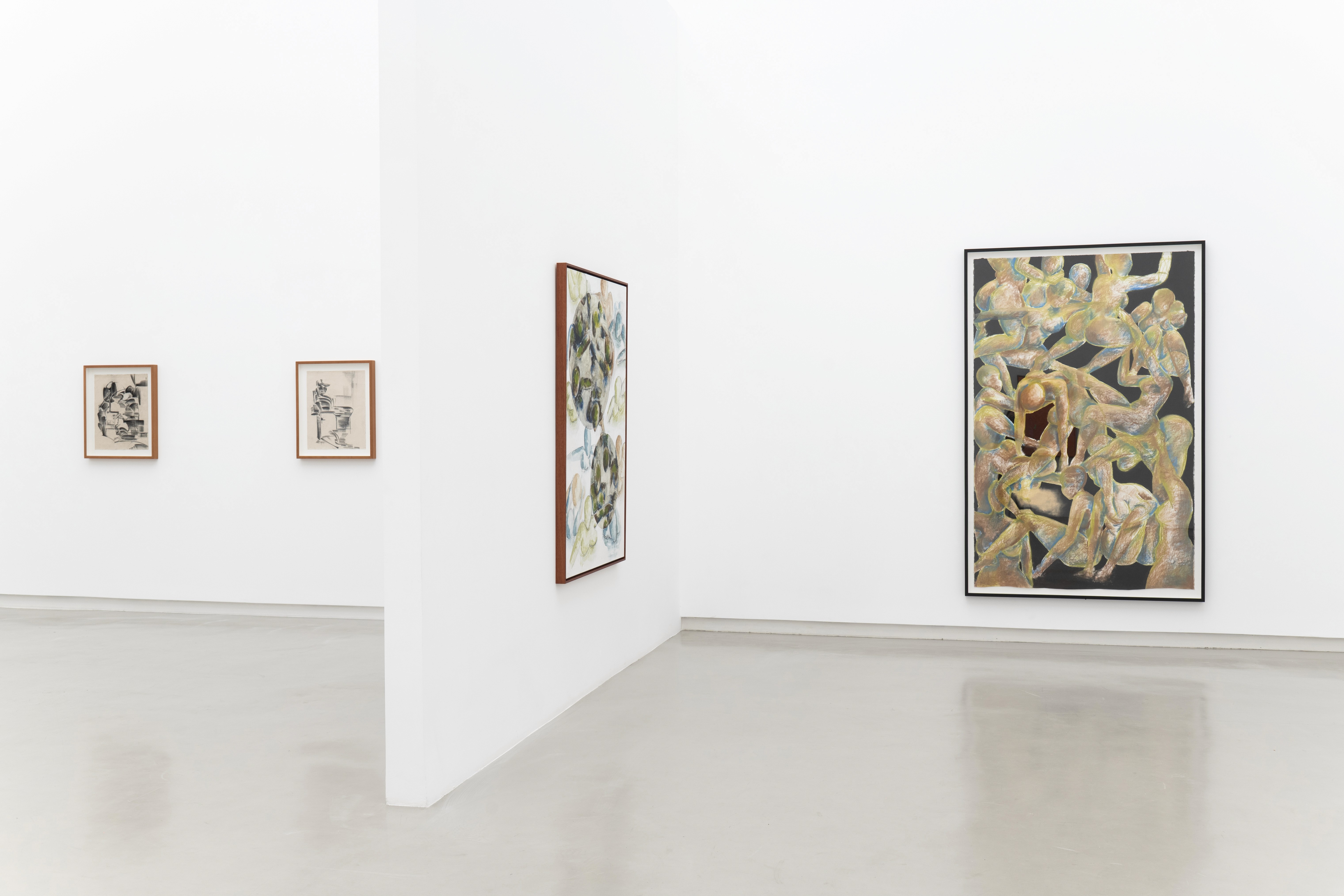
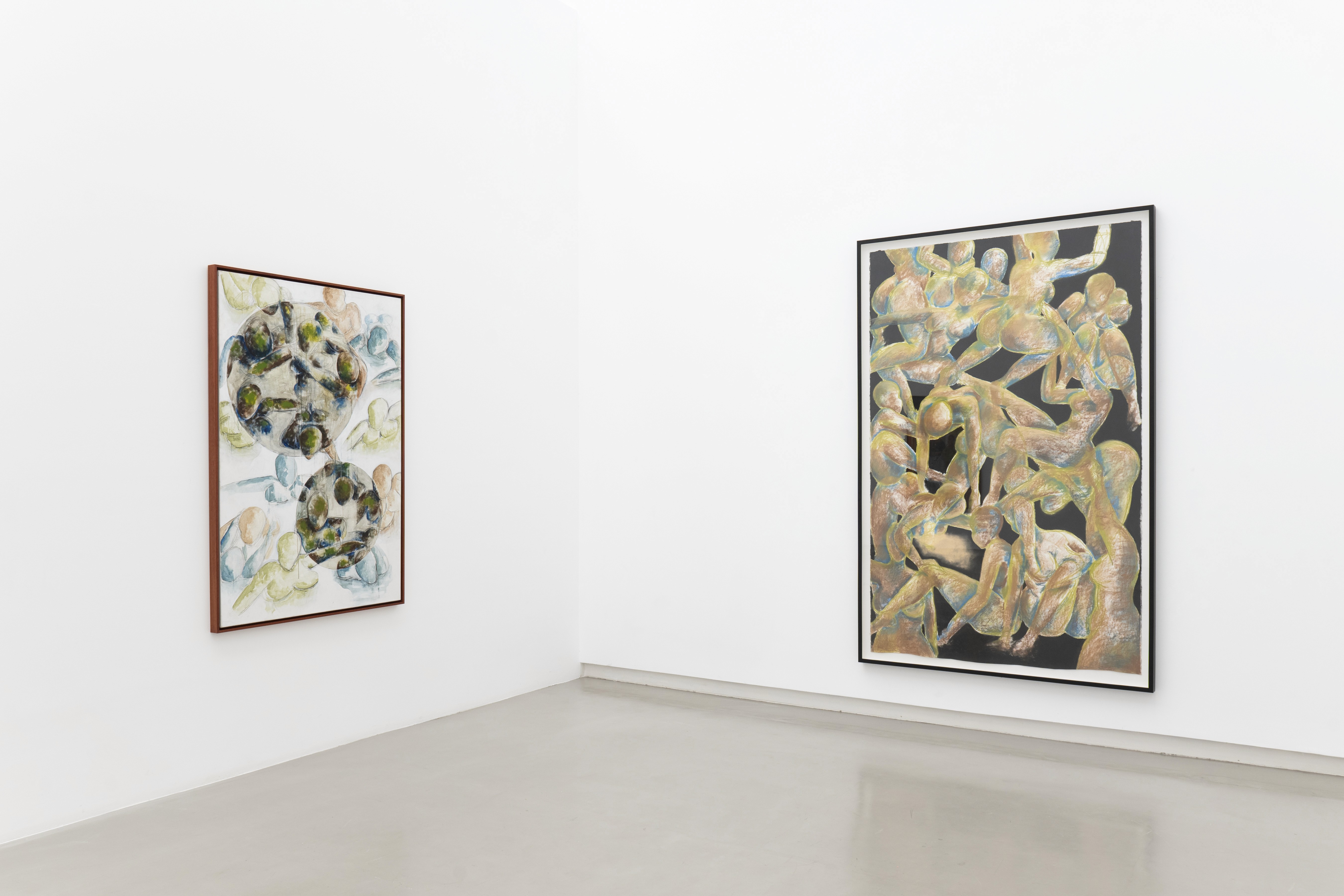
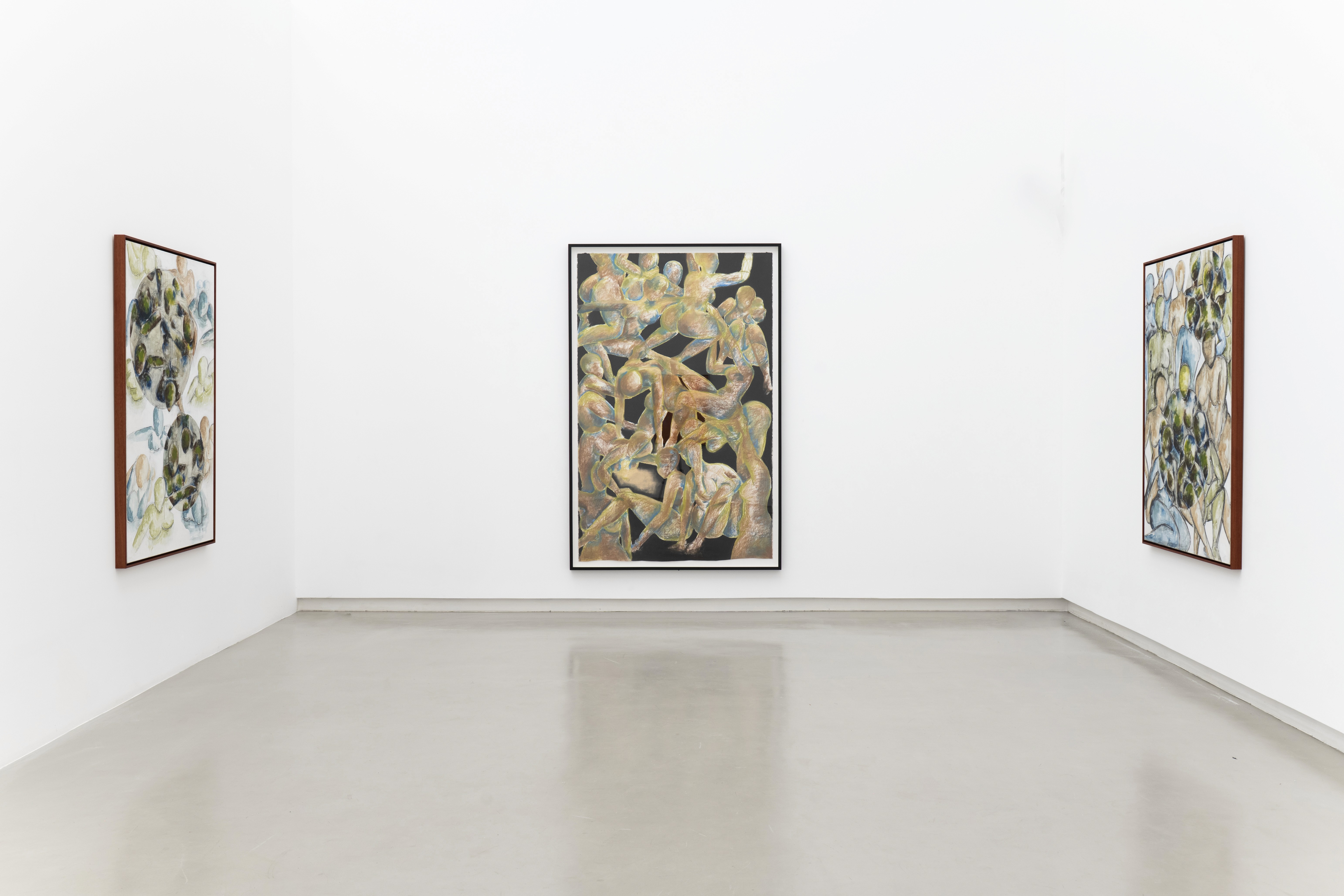
Naïla Opiangah's four works occupy perhaps the most intimate and philosophically searching territory of this exhibition. Her figures do not merely inhabit space, they construct it. In the twin oil paintings ore fields 1 and ore fields 2, built through layered oil, graphite, charcoal, and solvent, faceless female-coded forms are withheld from full identification, their rounded heads and limbs subsumed into smooth ovoid volumes. These shapes carry, perhaps unconsciously, the formal memory of Fang Byeri reliquary figures from Gabon, where the body is distilled into essential, almost geological solidity. In ore fields 2, the figures organize around two large oval portals, thresholds Opiangah returns to across her work, that read simultaneously as pools, vortexes, and openings onto elsewhere, refusing resolution into either presence or absence.
The monumental Victoire. Passé., chalk pastel and charcoal on paper sized 52 by 82 inches, is where the full architectural ambition of her vision declares itself. Bodies compound upon one another with the accumulated, tilting mass of a tower, their gestures elaborated with a theatricality reminiscent of Renaissance figure groupings, yet entirely fictive, drawn from imagination rather than observation. Alongside it, Mold et Poussière 2 distills this same vocabulary into an intimate scale, luminous forms glowing against a black ground with bioluminescent fragility. For Opiangah, who returned to her craft in the wake of profound personal loss, these works insist on existence as trembling persistence, forms refusing to fully disappear, holding their ground even as the ground itself remains unstable.
Édouard Glissant wrote of opacity, the right not to be made entirely legible, the refusal of transparency as a form of protection and as an act of love. It is a logic that runs beneath all four practices gathered here, and one that the title of this exhibition, in retrospect, was always reaching toward. In abstracto is not the opposite of in concreto. It is its condition, the inherited weight, the accumulated history, the abstract force that must be passed through before the particular, living, irreducible self can emerge on the other side. What Baldwin named as a remainder, what Glissant protected as a right, these four painters make visible as form. Not as illustration, not as argument, but as the thing itself: presence registered mark by mark, on surfaces that absorb, scar, and hold.