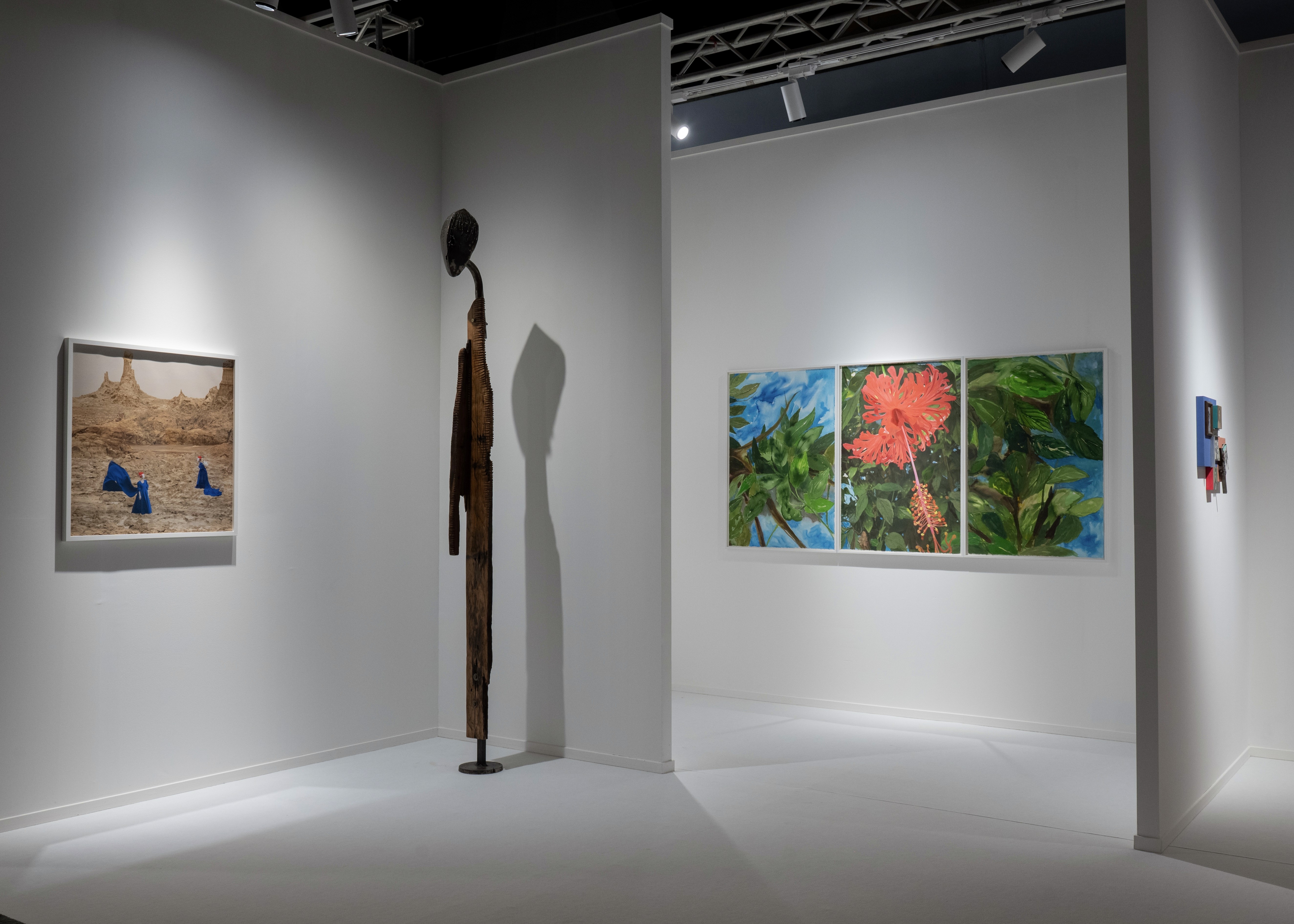
Where the Tide Flows, and the Dunes Gather | Yaw Owusu
16 November 2026 – 10 January 2027 Efie Gallery, Dubai United Arab Emirates

Efie Gallery is pleased to present Where the Tide Flows, and the Dunes Gather, a solo exhibition by acclaimed Ghanaian artist Yaw Owusu. Marking Owusu’s second solo exhibition with the gallery, the presentation coincides with Efie Gallery’s fifth anniversary and reflects a relationship that has developed alongside the gallery’s own evolving programme.
Bringing together works on paper, textured canvases, and mixed-media sculptures, Where the Tide Flows, and the Dunes Gather extends Owusu’s sustained inquiry into value: how it is assigned, circulated, diminished, and ultimately transformed. Working with materials already embedded within systems of exchange, Owusu considers currency not simply as an economic instrument, but as a social language through which hierarchies of worth are constructed and maintained.
Central to the exhibition is the unveiling of a new body of works on paper, created from the remnants and residue of the alchemical processes through which Owusu produces his sculptural works. These works introduce an inverse material logic to his practice. His sculptures, composed from some of the lowest-denomination coins in circulation, assume surfaces that shimmer with an almost golden luminosity. Through accumulation, repetition, and transformation, objects of negligible individual worth acquire an imposing material presence. The contradiction is deliberate: what appears precious is constructed from that which has been assigned little value.
Within this tension lies a wider social proposition. Owusu’s sculptures evoke the paradoxes upon which ideas of prosperity are often built: flourishing economies and societies sustained by forms of labour, material and human contribution whose value is frequently diminished or obscured. The works ask us to consider not only what a society values, but who determines value, who produces it, and who is permitted to possess it.
The works on paper turn this proposition inside out. Made from what remains after the sculptural process, their surfaces appear weathered, oxidised and almost rust-like, closer to erosion than ornament. If the sculptures transform the overlooked into something that resembles precious matter, the works on paper preserve the trace of that transformation: stains, sediments and residues that might otherwise disappear. What is conventionally understood as waste becomes both material and record.
In this reversal, Owusu complicates the distinction between value and residue. The exhibition proposes that every system of accumulation produces a remainder, and that what is left behind may reveal as much about a society as what it chooses to elevate. The paper works become, in this sense, abstract archives, surfaces upon which processes of extraction, exchange and transformation have quietly registered themselves.
The title, Where the Tide Flows, and the Dunes Gather, situates these questions within a broader meditation on movement and accumulation. Tides carry, erode and redistribute; dunes emerge gradually through the gathering of innumerable particles. Both are forms shaped by forces larger than their individual components. Across the exhibition, Owusu similarly considers how value, histories and societies are formed through accumulation, how the seemingly insignificant, repeated over time, can become monumental.
Presented in the year of Efie Gallery’s fifth anniversary, Where the Tide Flows, and the Dunes Gather marks both a continuation and an expansion of Owusu’s practice, bringing the object and its residue into dialogue and asking us to look again at what we deem precious, what we overlook, and what remains after value has been made.