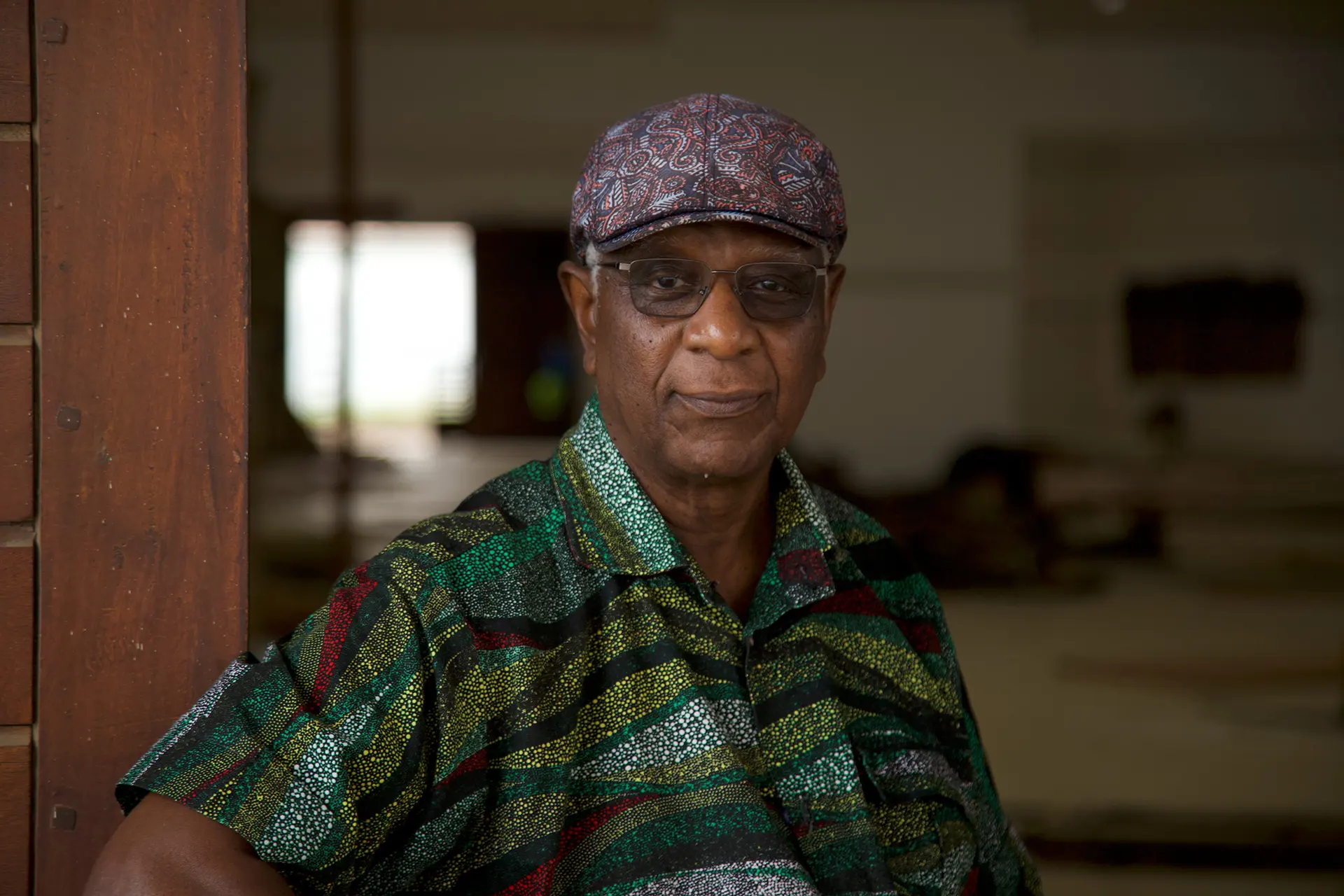
El Anatsui is among the most influential artists of his generation, whose pioneering practice has fundamentally expanded the possibilities of contemporary sculpture. Over a career spanning more than six decades, the Ghanaian artist has developed a singular visual language that transcends conventional distinctions between sculpture, painting, and textile, transforming everyday materials into intricate compositions that engage with histories of exchange, cultural memory, and the enduring relationship between material and meaning.
Central to Anatsui’s practice is an understanding of transformation as both a material process and a philosophical proposition. Working with discarded objects, including aluminium bottle caps, printing plates, cassava graters, and wood, he reconstitutes materials once embedded within systems of commerce and consumption into works of extraordinary formal complexity. His celebrated metal sculptures, composed of thousands of individually manipulated fragments joined by copper wire, unfold as monumental yet remarkably fluid surfaces. Simultaneously luminous and weighty, delicate and imposing, these works evoke the visual languages of weaving, painting, and abstraction while resisting classification within any single tradition.
Although deeply informed by the histories and material cultures of West Africa, Anatsui’s work extends beyond geographical and cultural boundaries, entering into a wider dialogue with the history of global abstraction. The materials themselves carry complex associations with colonial trade, consumption, labour, and the circulation of commodities, yet their transformation resists any singular interpretation. Rather than treating history as a fixed narrative, Anatsui approaches it as something continually reconstructed through material, gesture, and form. His sculptures embody this openness: conceived without a definitive configuration, they assume new dimensions and identities with each installation, inviting curators and institutions to participate in their continual reimagining. In doing so, Anatsui challenges the traditional conception of sculpture as a fixed and immutable object, proposing instead a practice defined by fluidity, possibility, and change.
Anatsui’s international prominence has been shaped by a succession of landmark institutional exhibitions and architectural interventions. At the 52nd Venice Biennale in 2007, his monumental installation Fresh and Fading Memories transformed the façade of the Palazzo Fortuny. This exploration of sculpture in dialogue with architecture continued with Broken Bridge at the Palais Galliera in Paris in 2012 and TSIATSIA – searching for connection at the Royal Academy of Arts, London, in 2013, for which he received the Charles Wollaston Award. Major institutional surveys have included When I Last Wrote to You About Africa at the Royal Ontario Museum, Toronto (2010); A Fateful Journey: Africa in the Works of El Anatsui at the National Museum of Ethnology, Osaka (2010); and Gravity and Grace: Monumental Works by El Anatsui, presented at the Brooklyn Museum, New York (2013).
In 2019, El Anatsui: Triumphant Scale, curated by Okwui Enwezor and Chika Okeke-Agulu, opened at Haus der Kunst, Munich, before travelling to Mathaf: Arab Museum of Modern Art, Doha, and Kunstmuseum Bern. The exhibition offered one of the most comprehensive examinations of his practice, situating his work within broader histories of modernism, abstraction, and contemporary sculpture. That same year, Anatsui participated in Ghana’s inaugural national pavilion at the 58th Venice Biennale.
A defining moment in his career came in 2023 with Behind the Red Moon, commissioned for Tate Modern’s Turbine Hall in London as part of the Hyundai Commission. Among his most ambitious installations, the work unfolded across three monumental sculptural formations, reflecting upon the movement of people, goods, and ideas across the Atlantic, and the histories of displacement, encounter, and transformation that accompany them. The installation further affirmed Anatsui’s ability to bring together intimate material gestures and expansive historical narratives on an architectural scale.
More recent institutional presentations have included El Anatsui: After the Red Moon at the Museum of Art Pudong, Shanghai (2024), further extending the international recognition of his practice. His work has also entered the realm of major public commissions, including a monumental installation conceived for the Vienna State Opera’s 2025–2026 season, demonstrating the continued evolution of his engagement with architecture and public space.
Anatsui’s relationship with Efie Gallery has encompassed both sculptural and interdisciplinary presentations. In 2022, the gallery presented Shard Song, followed in 2024 by Music, Fluidity and Reinvention: El Anatsui’s Record Collection, an exhibition that offered a distinct perspective on the artist’s intellectual and cultural influences through his personal collection of music. Together, these presentations reflect the breadth of a practice in which artistic disciplines, cultural histories, and forms of expression remain in constant dialogue.
Anatsui’s works are held in the permanent collections of leading international museums and institutions across Africa, Asia, Europe, North America, and the Middle East, including the Metropolitan Museum of Art, Museum of Modern Art, and Brooklyn Museum, New York; The Broad, Los Angeles; Los Angeles County Museum of Art; de Young Museum, San Francisco; Smithsonian National Museum of African Art, Washington, D.C.; Museum of Fine Arts, Boston; High Museum of Art, Atlanta; Seattle Art Museum; Denver Art Museum; Indianapolis Museum of Art; Saint Louis Art Museum; Nelson-Atkins Museum of Art, Kansas City; North Carolina Museum of Art; Des Moines Art Center; Akron Art Museum; Blanton Museum of Art, Austin; Fowler Museum, Los Angeles; Hood Museum of Art, Hanover; Royal Ontario Museum, Toronto; Tate and the British Museum, London; Centre Pompidou, Paris; Museum Kunstpalast, Düsseldorf; Musée Ariana, Geneva; 21st Century Museum of Contemporary Art, Kanazawa; Setagaya Art Museum, Tokyo; Leeum Museum of Art, Seoul; Jordan National Gallery of Fine Arts, Amman; Guggenheim Abu Dhabi, among others.
Anatsui has received numerous international distinctions, including the Golden Lion for Lifetime Achievement at the 56th Venice Biennale (2015) and the Praemium Imperiale for Sculpture from the Japan Art Association (2017). In 2023, he was named among TIME magazine’s 100 most influential people in the world, recognising an artistic legacy that continues to reshape understandings of sculpture and its place within the wider history of art.